

With the US-Iran conflict continuing, governments worldwide are desperately trying to curb the effect of soaring energy prices on populations.
Iran is one of the largest suppliers of natural gas (after the US and Russia) and coupled with its control of the key waterway, the Strait of Hormuz, the price of oil has rocketed to a near four-year high and wholesale gas prices have surged since the conflict began in February.
In response, governments across the globe have been implementing measures to try and offset the rise in costs felt by citizens.
Here’s what has been introduced so far and where.
Asia
While everyone is starting to feel the consequences of the conflict in Iran, Asian economies are disproportionately affected due to their dependence on oil and gas imports from the Middle East region.
In 2024, more than 80% of oil and liquefied natural gas (LNG) shipped through the Strait went to Asian markets, with China, India, Japan and South Korea the primary destinations, according to the World Economic Forum.
For this reason, many countries have started to take action.
Several Asian countries including the Philippines and Pakistan have introduced a four-day working week to cut back on fuel consumption while Sri Lanka has declared Wednesdays as public holidays for its government institutions, while Indonesia will implement a work from home day every Friday as well as limit fuel sales at 50 litres per-day from 1 April.
In Thailand, Prime Minister Anutin Charnvirakul also ordered civil servants on 10 March to conserve energy through a number of measures including working from home, setting air conditioning temperatures at 26-27C and swapping suits and ties for short-sleeved shirts instead.
Government officials have also been ordered to reduce electricity use at office buildings by switching off lights and electrical equipment when not needed and the public have been asked to cooperate in energy saving measures such as carpooling.
Watch Sky’s Helen-Ann Smith further analyse how these countries are dealing with the knock-on effects of the conflict:
Elsewhere, an order from the government in India published earlier in March, showed the country has invoked emergency powers and directed refiners to maximise production of liquefied petroleum gas (LPG), in order to try and prevent a shortage of cooking fuel.
Some IT conglomerates, including Cognizant, has gone as far as encouraging workers to start bringing in their own food to reduce dependence on commercial LPG-reliant cafeterias, according to The Economic Times newspaper.
On 4 March Myanmar’s government imposed sweeping fuel rationing system for private vehicles in response to what it called “global political situations”.
Under the scheme, cars with even-numbered plates will only be allowed to drive on even dates, and odd-numbered plates on odd dates. Electric vehicles and electric motorcycles are exempt.
Vietnam also plans to remove import tariffs on fuels until the end of April to ensure sufficient supply.
Europe
EU member states have been told to prepare for long-term disruption to energy markets by the bloc’s energy chief.
In a letter to ministers, seen by the Reuters, Dan Jorgensen said EU governments are “encouraged to make timely preparations in anticipation of a potentially prolonged disruption”.
However, the fallout on Europe’s energy supplies is currently contained, he said.
A number of European countries have announced fuel tax cuts and similar measures in recent days to try and combat price rises that have been driven by the war.
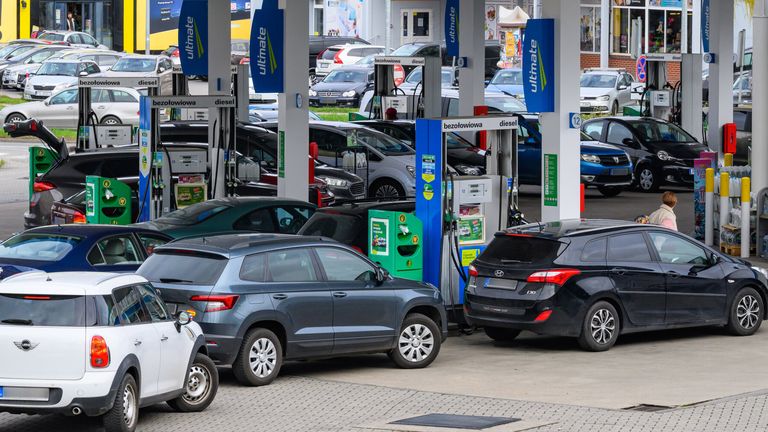
Vehicles from Germany queuing at petrol stations in Poland. Pic: AP
France and Greece have announced €70m and €300m in subsides for industries including fuel, farming and transport while Italy has set aside €417.4m to cut excise duty (a method of indirect taxation) on petrol and diesel until 7 April.
Deciding not to subsidise prices, petrol stations in Germany have instead been instructed to only increase fuel prices once a day.
In Spain, parliament is expected to vote on measures proposed by the government, including lowering fuel and electricity taxes and granting fuel subsidies to sectors most exposed to energy price spikes.
Away from the EU, the UK‘s Ofgem energy price cap means most households are protected from the impact of higher prices until the end of June, but prices are forecast to rise by almost £300 from the summer.
Chancellor Rachel Reeves has announced £53m in funding for low-income off-grid households using heating oil who have already been impacted by price rises.
For households generally, Ms Reeves has indicated that targeted support for those most in need is being considered rather than sweeping cost of living measures, which would be considerably more expensive.
Oceania
Two states in Australia have announced free public transport, to help with rising costs.
Jacinta Allen, the premier of Victoria, announced on 30 March that public transport would be free for the month of April to take “pressure off the pump”. She said the temporary measure would also help take cars off the road for people who have to drive.
In Tasmania, buses and ferries are set to be free for the next three months until 30 June.
All school bus services run by the government will also be free during the same period, according to the Australian Broadcasting Corporation.
Africa
A number of countries including Ethiopia and Namibia have put measures in place to help people afford fuel.
In order to conserve oil-powered electricity, the Egyptian government has ordered that all shops, restaurants and cafes shut at 9pm local time.
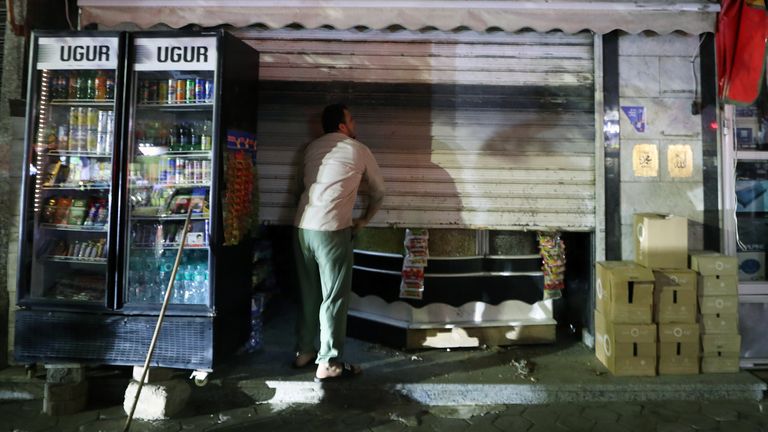
A man closing his shop due to earlier closing hours in Egypt. Pic: AP
The measures, which have been described by the government as “exceptional”, also include dimming streetlights and roadside advertising.
Civil servants have also been asked to return to working from home for one day a week throughout the month of April.
Major tourist areas are exempt from the energy-saving measures including the Red Sea resorts of Hurghada, Sharm el-Sheikh, Marsa Alam, as well as the southern cities of Aswan and Luxor.
Egypt has been hit particularly hard by rising energy prices. Prime Minister Mustafa Madbouly said the nation’s oil bill has more than doubled compared to January.


Leave a Reply